
StudyBuddy Pro
  • Law Study Aids
    • Case Briefs
    • Lessons
      • 1L
        • Civil Procedure
        • Constitutional Law
        • Contracts
        • Criminal Law
        • Property Law
        • Torts
      • 2L/3L
        • Business Organizations & Associations
        • Criminal Procedure
        • Evidence
        • Family Law
        • Secured Transactions
        • Wills, Trusts & Estates
    • Outlines
      • 1L
        • Civil Procedure
        • Constitutional Law
        • Contracts
        • Criminal Law
        • Property Law
        • Torts
      • 2L/3L
        • Agency
        • Business Organizations & Associations
        • Conflicts of Law
        • Corporations
        • Criminal Procedure
        • Evidence
        • Family Law
        • Intellectual Property
        • Partnerships
        • Secured Transactions
      • Exam Prep Checklists
        • Access 1L Checklists
          • Civil Procedure
          • Constitutional Law
          • Contracts
          • Criminal Law
          • Property Law
          • Torts
        • Access 2L/3L Checklists
          • Agency
          • Criminal Procedure
          • Corporations/Business Entities
          • Evidence
          • Family Law
          • Partnership
          • Trusts
          • U.C.C. ART. 9
          • Wills
    • Refresher Courses
      • 1L
        • Constitutional Law
        • Contracts Law
        • Criminal Law
        • Property Law
        • Torts Law
      • 2L/3L
        • Criminal Procedure
        • Evidence Law
    • Exam Prep Pro
      • 1L
        • Civil Procedure
        • Constitutional Law
        • Contracts
        • Criminal Law
        • Property Law
        • Torts
      • 2L/3L
        • Business Organizations & Associations
        • Conflicts of Law
        • Criminal Procedure
        • Evidence
        • Family Law
        • Secured Transactions
        • Wills, Trusts & Estates
    • Multiple Choice Quizzes
      • 1L
        • Civil Procedure
        • Constitutional Law
        • Contracts
        • Criminal Law
        • Property Law
        • Torts
      • 2L/3L
        • Business Organizations & Associations
        • Conflicts of Law
        • Criminal Procedure
        • Evidence
        • Family Law
        • Secured Transactions
        • Wills, Trusts & Estates
    • Exam Prep Workshops
      • 1L
        • Civil Procedure
        • Constitutional Law
        • Contracts
        • Criminal Law
        • Property Law
        • Torts
    • Charts and Notes
      • 1L
        • Civil Procedure
        • Constitutional Law
        • Contracts
        • Criminal Law
        • Property Law
        • Torts
      • 2L/3L
        • Criminal Procedure
        • Evidence
  • Courses
    • 1L Prep Course
  • Solutions
    • Professors and Institutions
    • Prompter Pro
    Generic selectors
    Exact matches only
    Search in title
    Search in content
    Post Type Selectors
    Advanced Search | Notes Search
    Start My FREE 7-DAY Trial
    Log In
    StuddyBuddy Pro
    Apple
    Facebook
    Google

    Forgot Password?

    Forgot Password?

    Forgotten Password

    Cancel

    Generic selectors
    Exact matches only
    Search in title
    Search in content
    Post Type Selectors

    • Law Study Aids
      • Case Briefs
      • Lessons
        • 1L
          • Civil Procedure
          • Constitutional Law
          • Contracts
          • Criminal Law
          • Property Law
          • Torts
        • 2L/3L
          • Business Organizations & Associations
          • Criminal Procedure
          • Evidence
          • Family Law
          • Secured Transactions
          • Wills, Trusts & Estates
      • Outlines
        • 1L
          • Civil Procedure
          • Constitutional Law
          • Contracts
          • Criminal Law
          • Property Law
          • Torts
        • 2L/3L
          • Agency
          • Business Organizations & Associations
          • Conflicts of Law
          • Corporations
          • Criminal Procedure
          • Evidence
          • Family Law
          • Intellectual Property
          • Partnerships
          • Secured Transactions
        • Exam Prep Checklists
          • Access 1L Checklists
            • Civil Procedure
            • Constitutional Law
            • Contracts
            • Criminal Law
            • Property Law
            • Torts
          • Access 2L/3L Checklists
            • Agency
            • Criminal Procedure
            • Corporations/Business Entities
            • Evidence
            • Family Law
            • Partnership
            • Trusts
            • U.C.C. ART. 9
            • Wills
      • Refresher Courses
        • 1L
          • Constitutional Law
          • Contracts Law
          • Criminal Law
          • Property Law
          • Torts Law
        • 2L/3L
          • Criminal Procedure
          • Evidence Law
      • Exam Prep Pro
        • 1L
          • Civil Procedure
          • Constitutional Law
          • Contracts
          • Criminal Law
          • Property Law
          • Torts
        • 2L/3L
          • Business Organizations & Associations
          • Conflicts of Law
          • Criminal Procedure
          • Evidence
          • Family Law
          • Secured Transactions
          • Wills, Trusts & Estates
      • Multiple Choice Quizzes
        • 1L
          • Civil Procedure
          • Constitutional Law
          • Contracts
          • Criminal Law
          • Property Law
          • Torts
        • 2L/3L
          • Business Organizations & Associations
          • Conflicts of Law
          • Criminal Procedure
          • Evidence
          • Family Law
          • Secured Transactions
          • Wills, Trusts & Estates
      • Exam Prep Workshops
        • 1L
          • Civil Procedure
          • Constitutional Law
          • Contracts
          • Criminal Law
          • Property Law
          • Torts
      • Charts and Notes
        • 1L
          • Civil Procedure
          • Constitutional Law
          • Contracts
          • Criminal Law
          • Property Law
          • Torts
        • 2L/3L
          • Criminal Procedure
          • Evidence
    • Courses
      • 1L Prep Course
    • Solutions
      • Professors and Institutions
      • Prompter Pro
    Start My FREE 7-DAY Trial
    Log In Sign up
    StuddyBuddy Pro
    Apple
    Facebook
    Google

    Forgot Password?

    Forgot Password?

    Forgotten Password

    Cancel
    SmartBrief enables case brief popups that define Key Terms, Doctrines, Acts, Statutes, Amendments and Treatises used in this case.

    SmartBrief

    A.I Enhanced Margin Brief to quickly recall case brief A.I Enhanced Margin Brief to quickly recall case brief 0

    Sections to print


    To print, please Start a Free Trial or Log in.

    Confirm favorite deletion?

    Cancel Yes, Delete

    Torts Keyed to Twerski

    View this case in different Casebooks
    Torts Keyed to FranklinTorts Keyed to Henderson

    Fletcher v. Rylands

    Citation:

    L.R. 1 Exch. 265 (1866)
    Start Your Free Trial or Log in.

    Facts

    The Defendants’ constructed and maintained a reservoir on their land. Defendants and the contractors they hired were unaware of an issue with the subsoil, which caused the reservoir to break. Subsequently, water damaged the Plaintiff’s neighboring land. Plaintiff sued Defendants for the damage.

    Only StudyBuddy Pro offers the complete Case Brief Anatomy*

    Access the most important case brief elements for optimal case understanding.

    *Case Brief Anatomy includes: Brief Prologue, Complete Case Brief, Brief Epilogue

    • The Brief Prologue provides necessary case brief introductory information and includes:
    • Topic:

      Identifies the topic of law and where this case fits within your course outline.
    • Parties:

      Identifies the cast of characters involved in the case.
    • Procedural Posture & History:

      Shares the case history with how lower courts have ruled on the matter.
    • Case Key Terms, Acts, Doctrines, etc.:

      A case specific Legal Term Dictionary.
    • Case Doctrines, Acts, Statutes, Amendments and Treatises:

      Identifies and Defines Legal Authority used in this case.
    Start Your Free Trial or Log in.
    • The Case Brief is the complete case summarized and authored in the traditional Law School I.R.A.C. format. The Pro case brief includes:
    • Brief Facts:

      A Synopsis of the Facts of the case.
    • Rule of Law:

      Identifies the Legal Principle the Court used in deciding the case.
    • Facts:

      What are the factual circumstances that gave rise to the civil or criminal case? What is the relationship of the Parties that are involved in the case.
    • Issue(s):

      Lists the Questions of Law that are raised by the Facts of the case.
    • Holding:

      Shares the Court's answer to the legal questions raised in the issue.
    • Concurring / Dissenting Opinions:

      Includes valuable concurring or dissenting opinions and their key points.
    • Reasoning and Analysis:

      Identifies the chain of argument(s) which led the judges to rule as they did.
    Start Your Free Trial or Log in.
    • The Brief Prologue closes the case brief with important forward-looking discussion and includes:
    • Policy:

      Identifies the Policy if any that has been established by the case.
    • Court Direction:

      Shares where the Court went from here for this case.
    Start Your Free Trial or Log in.

    Case Quiz

    Retake Attempts
    Question 1 of 3

    Results

    0 of 3 Questions answered correctly.

    Results

    Quiz complete. Results are being recorded.
    Q.1 - Which proposition most precisely captures the juridical function of the “non-natural use” qualification in Rylands v. Fletcher as a limiting principle on liability for escape-based harms?
    Start Your Free Trial or Log in.
    Incorrect. The doctrine does not turn on a negligence-style inquiry into reasonableness.
    Correct! This answer is correct because the “non-natural use” requirement operates as the doctrine’s principal limiting device, restricting strict liability to abnormal accumulations that exceed the baseline risks neighboring landowners ordinarily must tolerate. It is also correct because the qualification preserves Rylands from becoming a general regime of insurer-like liability for every harmful escape associated with ordinary land use.
    Incorrect. The case does not require that the substance be inherently dangerous in every quantity or context.
    Incorrect. The qualification is not merely a proxy for foreseeability of the precise escape mechanism.
    Q.2 - Why, at the highest level of doctrinal abstraction, did the House of Lords affirm liability notwithstanding both Rylands’s lack of personal negligence and the role of independent contractors in constructing the reservoir?
    Start Your Free Trial or Log in.
    Correct! This answer is correct because the Lords treated liability as arising from the defendant’s legally significant act of accumulating and keeping a dangerous or potentially harmful thing on land for a non-natural purpose, not from personal moral blame. It is also correct because once liability is structured around escape from abnormal accumulation, neither ignorance of hidden shafts nor reliance on contractors defeats the allocation of risk to the party who created the dangerous condition.
    Incorrect. The judgment was not grounded in ordinary vicarious liability doctrine.
    Incorrect. The case was not decided as a straightforward trespass action.
    Incorrect. The House of Lords did not predicate liability on constructive negligence.
    Q.3 - Which of the following most sharply identifies the deepest conceptual instability within the Rylands framework when viewed as a freestanding tort doctrine rather than as a historical precursor to modern strict liability?
    Start Your Free Trial or Log in.
    Incorrect. Although overlap with nuisance exists, redundancy is not the doctrine’s deepest conceptual problem.
    Incorrect. The mere inclusion of water does not itself prove the doctrine is facially overinclusive.
    Correct! This answer is correct because the doctrine’s coherence depends on identifying when a use is sufficiently “non-natural” to justify strict liability, yet that category lacks stable internal content and is often defined by the very risk judgment it is supposed to constrain. It is also correct because this indeterminacy makes the doctrine vulnerable to circularity: courts may classify a use as non-natural because harm occurred, rather than using the category as an independently determinate rule.
    Incorrect. Rejecting negligence does not eliminate the need to prove causation.

    MarginBrief™ Case overview for optimal recall

    A.I Enhanced Margin Brief to quickly recall case brief
    A.I Enhanced Margin Brief to quickly recall case brief

    Generating...

    Facts:

    Quickly review the Facts of this case including its key ideas for optimal understanding and recall.

    Quickly review the Facts of this case including its key ideas for optimal understanding and recall.

    Issue:

    Utilize our powerful A.I. tools to easily capture and understand the Issue in this case.

    Utilize our powerful A.I. tools to easily capture and understand the Issue in this case.

    Rule:

    Easily understand the Rule in this case so you have a complete and thorough appreciation for overall case concepts completely tying together what occurred, the court’s questions and the case outcome.

    Easily understand the Rule in this case so you have a complete and thorough appreciation for overall case concepts completely tying together what occurred, the court’s questions and the case outcome.

    Start Your Free Trial or Log in.

    Topic Resources

    Topic Video

    Fletcher v. Rylands4m 52s
    See complete Lesson, Quizzes and More

    Topic Outline

    Strict Liability

    Topic Refresher Course

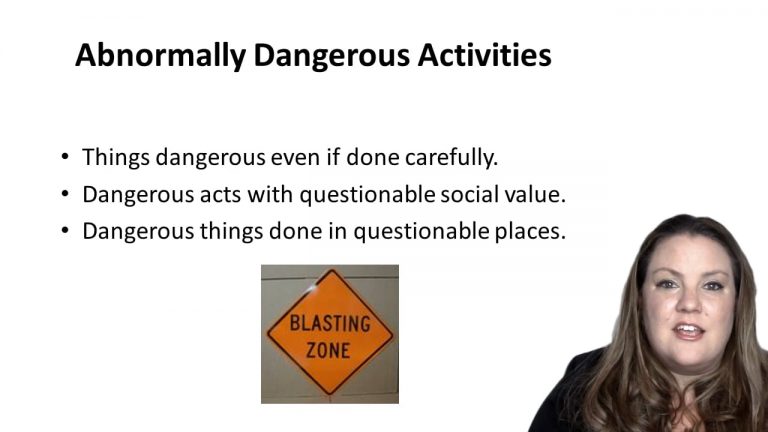
    Ultrahazardous Activiites

    Status:

    Your Law School
    Success Begins Here

    • Case Briefs - the Socratic Savior! – Best in class and Largest Library of complete I.R.A.C. / C.R.E.A.C. Law School case briefs. Includes:
      • SmartBriefs® - Enhanced case briefs for optimal clarity
      • New Case Videos - Explained and Summarized for optimal case understanding
      • CaseCast® - Professor overviews of "What you need to know"
      • New MarginBrief® - A.I. - Powered for faster, more efficient case recall
    • Lessons - Professor delivered video for topic reinforcement
    • Outlines - Professor written - downloadable, amendable and includes test-taking tips and tools
    • New Case Quiz - Reinforce case principles, instantly scored
    • Refresher Courses - Quick course reviews with interactive exercises
    • Quizzes and Exams - over 5,000 Multiple Choice and Essay questions all Professor curated and answered
    • New My Reviewer™ - Instantly receive a Score, Critique and Feedback on your legal writing
    • Exam Prep Workshops - Delivered by Professors on how to disect, organize and answer law school exam questions
    • and so much more ...
    Start your FREE Trial

    Notepad Click anywhere in notepad to add a note

    Fletcher v. Rylands